Pages

Showing posts with label story structure. Show all posts

June 19, 2018

8 Things Writers Can Learn from Mary Poppins


By Gary Fearon


Richard M. Sherman and his brother Robert B. Sherman may not be household names, but the story songs they wrote are beloved worldwide via Walt Disney films and parks, including what they considered their crowning glory, Mary Poppins. Along with their Oscar-winning score, the Shermans were key players in developing the story structure.

Last Tuesday, June 12th, was Richard M. Sherman's 90th birthday. In his honor, here are eight things all writers can learn from the prolific songwriting team Walt himself affectionately referred to as "the boys".

COMBINE USEABLE IDEAS
There are eight books in the Mary Poppins series. Scenes and concepts from different books were brought together to create a storyline for the classic 1964 screenplay. Are there any ideas you've  put aside that could find a new home in your latest work?

FIND THE REAL STORY
The magical English nanny had many colorful adventures, but Richard & Robert determined that these episodes had no character arcs and weren't enough to carry a story. They convinced Disney that Mary's employers should be distracted parents who rediscover the joy of childhood along with their children. Once a moral was chosen, the adventures took on a common purpose.

COME UP WITH A NEW TWIST
For Mary's signature song, the Shermans wanted to give her a clever proverb, like "An apple a day..." or "A stitch in time..."  The end result ("A spoonful of sugar helps the medicine go down") was inspired by Robert's young son, whose school had administered a polio vaccine placed on sugar cubes for easier consumption. You never know what phrase you write could become an instant classic.

SECONDARY CHARACTERS ARE PEOPLE TOO
In the books, Bert was only a minor character, a street artist known as The Match Man. He has much more prominence in the film, and his role as a chimney sweep was borrowed from a different character in the P.L. Travers series. Bert was given a presence and personality strong enough to be a companion for Mary Poppins. His equally charismatic signature song, "Chim Chim Chiree", won the 1965 Oscar for Best Original Song.

PICK THE RIGHT TIME PERIOD
The Shermans moved the story from the depression-era 1930s to the more hopeful turn of the century. Setting the story in 1910 London also allowed them to develop one character into a suffragette. Speaking of whom...

RISE TO THE CHALLENGE
Actress Glynnis Johns thought she had been cast to get the title role of Mary Poppins, only to learn that Julie Andrews had already been enlisted to play the title role. Walt appeased her by assuring her that the Shermans had written an especially great song just for her to sing. In truth, it wasn't even a thought up to that point. But Richard and Robert picked up the gauntlet and delivered a big and brassy number to give her lesser character a chance to shine.

SAVE SOME THINGS FOR A RAINY DAY
The Shermans wrote 32 songs for possible inclusion in Mary Poppins, but only 14 were used when Walt declared the rest "unnecessary" for the story. Some were repurposed in later Disney features including Bedknobs and Broomsticks and The Jungle Book.

CLOSE THE DOOR
The Sherman brothers avoided distractions like the plague. When it was time to write, they shut out the world around them to concentrate on the project at hand. 

In everything they wrote, Richard and Robert believed that story always comes first. By adopting that same focus, we can give our writing a little extra magic that is practically perfect in every way.

March 6, 2018

When Bad Things Happen to Good Protagonists


by Gary Fearon, Creative Director, Southern Writers Magazine


Perfection is boring, said more than one writer and even more readers. We can appreciate perfection, of course, as in a gorgeous sunset.  But when we're seeking to be entertained, it's all about the imperfection of things going badly for the hero.

No one seeks hardship upon themselves, and when given the choice we will choose the lesser of two evils. Our hero has the same instinct for self-preservation, so he/she will try to avoid trouble at all cost. Which is why problems must be thrust upon them, usually by someone with an opposing agenda.    

"Good people do not need laws to tell them to act responsibly," said Plato, "while bad people will find a way around the laws." This great forefather of fiction knew that characters with a propensity for doing bad are good at creating conflict for a sympathetic hero. When trouble strikes as a result of an outside force, our innocent victim is considered a passive protagonist.

On the other hand — just as in real life — trouble can be self-inflicted, caused by the hero's own carelessness, bad judgment, stubbornness, or other misstep. This active protagonist can attract adversity, if only via good intentions gone wrong. They had set out to accomplish something, only to have it go awry.

In general, writers are told to avoid the passive protagonist because readers don't invest themselves as readily in a hero who things merely happen to. They wish to identify with someone who wants something and is intent on getting it.

The ideal plot, it would seem, will star an active protagonist capable of causing his own calamity (the archetypical flawed hero), only to be further thwarted by an equally active antagonist who brings even more tribulation to the table. Our poor imperfect protagonist can't get a break. They have an enemy but can also be their own worst enemy.

The goal is to pile on however much misfortune it takes to convince the reader that all is lost; that there's no possible way the hero is going to come out on top. They will, of course. But it's all the stumbles threatening that victory which keep the reader turning the page, since trouble — no matter who's causing it — is just plain interesting.


August 8, 2017

Writing Like a View-Master


by Gary Fearon, Creative Director, Southern Writers Magazine


It's been a long time since I hung out in the toy department, but on a recent visit I was surprised to see that one of my childhood favorites was still around. Perhaps at some point you also owned a View-Master. I can still hear the voice of actor Henry Fonda hawking "the G.A.F. View-Master" on TV spots.

This plastic viewer, held up to the eyes like a pair of binoculars, let you experience genuine 3D images. Depending on which disc you inserted, you could see stereoscopic views of everything from the Grand Canyon to popular TV shows. Grimm's Fairy Tales and stories from the Disney archive were among the more popular titles.

As you manually advanced to each of the seven scenes on a disc, a tiny window displayed a few words describing what you were seeing.  Which meant that an entire story had to be told in seven scenes.

Does that tell you something?  What it suggests to me is that a good story can be broken down and told in as few as seven simple plot points.

Apparently the View-Master isn't alone in thinking this way.  Numerous writing resources spell out classic seven-point outlines.  There are variations, but here's a common breakdown:

1. The Beginning
A setup that establishes the character in his/her current circumstances.

2.  Plot Point 1
An inciting event, a catalyst that changes the status quo.

3.  Pinch Point 1
A personal challenge that requires the hero to take action.

4.  Mid-Point
At this point of no return, the hero is fully committed and proactively tries to fix things.

5.  Pinch Point 2
The hero fails. At this low point an additional crisis makes it appear that all is lost.

6.  Plot Point 2
The final confrontation with the antagonist.  Most of the time, the hero will prevail.

7. Ending
This satisfying epilogue reveals how things are in the new normal.

In an 80,000-word novel, that translates to roughly 11,400 words for each point.  But if you break your story down to its key elements, you could convey it in a one-minute summary suitable for an elevator pitch or a workable outline for whatever novel you're working on.

Granted, a picture is worth a thousand words — and the View-Master showed seven of them — but the brief text that accompanied each slide told the same story in the sparsest words possible.  When plotting your next story or pitching to an agent, think like a View-Master and you can stir your reader's imagination in vivid 3D.

February 6, 2017

The Other Faces of Conflict


by Gary Fearon, Creative Director, Southern Writers Magazine


When we think of antagonists from literature, we typically think of the classic villains like Captain Hook, Injun Joe, The Wicked Witch of the West, Hannibal Lecter, Dracula, and the other memorable personifications of evil.  But there are many other faces of conflict not of the human variety that can be put to good use in a story.

Many children's books choose not to pit the hero against another person.  Instead, the dilemma comes from a small difficulty that can be turned into a problem-solving life lesson.  A terrific example is Pete the Cat, who loves his white shoes. When he steps in strawberries that turn his shoes red, what follows is a simple but brilliant story about learning to accept and love yourself, cleverly disguised as a tale about shoes.

Even as adults, conflict in story teaches us to deal with life, each dilemma in its own small way representing the eternal struggle.  A problem is a problem, no matter what form it takes.  Here, then, are some classic inhuman antagonists:

Man vs Beast
What's worse than someone you can't even reason with?  How about someone that wants to eat you? Ask the heroes of Jaws if their adversary doesn't pose a lethal threat.  The irony is that the shark isn't fishing for trouble; he's just doing what comes naturally 'cause it's feeding time.  Likewise, the great white whale in Moby Dick may or may not understand the concept of revenge, but it knows all about self-preservation.

The Great Outdoors
Stephen King's The Girl Who Loved Tom Gordon is one of many examples of a protagonist trying to survive in the wilderness. Again, there is irony in the fact that a forest, waterfall, mountain, etc mean no harm; they don't even have a conscience.  But it's a jungle out there, and a babe in the woods goes back to basic human survival.

Not to say that a tornado or a tempest can't stir up some additional trouble on their own.  The Perfect Storm, Earthquake and Twister are cinematic examples of how Mother Nature can be a real shrew.

Hard Times
Nellie Olsen wasn't the only thorn in Laura Ingalls' side in her Little House on the Prairie books.  Tales set in the Old West are particularly filled with the struggle just to make it through life under primitive or poverty-stricken conditions. Mix in some of the previous elements like a grizzly bear or no rain for growing crops and you have a multi-layered prairie of pain.

Conflict in Nonfiction
Even when we're writing nonfiction, it's not hard to find conflict because life wouldn't be life without it.  My recently-published short story "Family Tree" in Stories of Music, Volume 2 is primarily a retrospective of the musical family I grew up in.  I wasn't particularly seeking a way to add conflict or even drama to this memoir; it just happened organically because it was a tragedy that put a stop to the musical collaboration in my family, and, ironically, another tragedy is what brought it all back with new magic.

A good guy facing off against a bad guy is classic drama.  But fighting off the challenges of everyday life are readily available story helpers to add extra conflict, or take it out of the mano a mano realm altogether.


January 10, 2017

Causing Trouble


by Gary Fearon, Creative Director, Southern Writers Magazine


Most sane people don't go around looking for trouble.  In fact, they do their best to avoid it. More often than not, trouble finds them instead. A flat tire, a power outage, a computer crash — no one anticipates calamity, much less extends an invitation to it.

But when conjuring up a story, mayhem can be our best friend.

Since conflict gives fiction its fire, we do well to put our natural human instinct for self-preservation aside and actively invoke troubled times, at least for our main character. The better the obstacles between them and their goal, the more compelling the story.

Since trouble comes in many different flavors, the genre will often dictate the appropriate realm of ruin to choose from. A lover's quarrel that would send Bridget Jones running to her diary is unlikely to hound Sherlock Holmes while investigating a Baskerville murder. Deciphering whether alien messages are friendly or declarations of war would probably be too out of this world for a child's book.

Indeed, the age and life circumstances of the intended reader is a ready yardstick for measuring the severity of impending doom. Dealing with a school bully is sufficient drama for a student reader, while a mature audience is capable of pondering the end of mankind. If your protagonist is the approximate age of your typical reader, it's easy to throw the appropriate curveballs their way and have them struggle authentically.

The most tried-and-true obstacle is another character who seeks the opposite outcome. The murderer will do everything in his power to prevent being captured. The handsome rancher has vowed never to fall in love again. A cut-throat coworker connives to get the big promotion instead of our hero.

As we know, making trouble for our protagonists is simply a matter of giving them a goal and then putting roadblocks in their way. We can think of our storyline as a maze, where the hero/heroine knows where they need to go, but getting there is just one problem after another thanks to all the obstacles in the way.

"The trouble with trouble," it's been said, "is that it always starts out as fun."  Have fun being the real troublemaker in your story.  It's the one time you don't have to worry about getting punished.


October 4, 2016

Didn't See It Coming


by Gary Fearon, Creative Director, Southern Writers Magazine


(image of Lucy saying, "Life is full of surprises.")
People love surprises when it's something good like an unexpected gift or bumping into an old friend at the grocery store. Other surprises, say an eviction notice or a fender bender, not so much.  But one thing readers always enjoy is the element of surprise in a story.

It's no surprise that mystery readers analyze every clue they can find in an attempt to figure out whodunit, and indeed the whole point is to earn the right to say, "I knew it all along."  But it's an added bonus if something that didn't even seem like a clue turns out to be a missing link.  

However, red herrings needn't be limited to mysteries. Don't you love it when someone who works for the bad guy ends up becoming an ally of the good guy? Turning the tables in a twist that compliments the plot or complicates things for the hero makes a story come alive.

Many a tale has benefited from an important person or prop initially dismissed as inconsequential.  A man we thought was a blind beggar warns a young guy about an angry girlfriend he saw enter the apartment building. A birthday bouquet we assumed was sent to a nursing home invalid by her daughter was actually arranged for by a fellow patient.

(photo of surprised cat)
This cat never suspected a thing.
Another very popular technique is to surprise not the reader, but rather the main character.  Let the audience know the hero is about to inherit a circus.  Reveal that the in-laws are arriving for Thanksgiving a day early in hopes of pleasing the newlyweds.  Being in on an upcoming surprise gives the reader omnipotence, and the anticipation of what will happen when the protagonist finds out allows them to be a virtual participant in the story.

Perhaps the most powerful surprise of all is when the ending turns everything upside down and makes you rethink the meaning of the entire story.  The Sixth Sense and Planet of the Apes did that, and I can't help thinking of Psycho whenever I think of rethinking. 

Predictability has a certain comfort factor to it, but it's the element of surprise that enthralls and keeps readers coming back for more.  If you find your story is lacking momentum, inject the unexpected.  You may be pleasantly surprised.


April 19, 2016

Catalyst on a Hot Tin Roof


by Gary Fearon, Creative Director, Southern Writers Magazine


One of the most intriguing parts of any tale is the inciting incident.  That turning point—when the main situation of the plot is set into motion—is when we find ourselves committed to the story to see how things are going to play out.

By this point we've usually gotten to know the characters and their normal circumstances.  Just as we've gotten acclimated, along comes the catalyst that turns everything upside down.
Back to the Future: Marty's about to lose track of time
In Back to the Future that moment comes when Marty escapes terrorists by speeding away in Doc Brown's time machine and finds himself transported back to 1955.

In most cases, the inciting incident is something that happens to the hero, not something he or she causes.  Even in The Hunger Games, when Katniss makes the decision to take her sister's place in the deadly contest, it is because she is forced by her own sense of duty to do so.

In a romantic tale, multiple events will come along to complicate things, but it's the moment the lovebirds first lay eyes on each other than can usually be considered the one that turns everything topsy-turvy.

Katniss pays tribute to her sister in The Hunger Games
How soon in the story it should take place will vary, but plotters generally agree that this catalytic converter should occur during the first quarter.  For example, in Back to the Future, it happens at exactly the 1/4 mark, 30 minutes into the two-hour movie.  In The Hunger Games, it occurs only 15 minutes into the 2 1/2 hour flick.

In a different kind of example, the Oscar winner American Beauty centers around Lester's midlife crisis, which is triggered by more than one thing, including a lousy job and a cheating wife.  But the pivotal moment comes when he attends a school event and becomes enamored with his daughter's friend.  Everything prior is setup.  That inciting incident, for the record, takes place 15 minutes into the two-hour film.

Lester's life is about to change, and not for the better
Basically, the inciting incident is the event without which the main story cannot happen.  Doc Brown can invent a time machine, hunger games will take place no matter what, and Lester's unsatisfying life is already underway, but without these other key moments, the main crisis will not be inflicted upon the hero.

The most effective inciting incident will cause the audience to wonder how in the world he/she is gonna prevail over this problem.  At the very least, it will set the stage for bigger crises to increase the dilemma later.

Done right, this turning point will not only ignite the TNT of your story, but will become the no-turning-back moment for your reader too.


December 15, 2015

Creative Recalibration


by Gary Fearon, Creative Director, Southern Writers Magazine


So I was wandering around at Lowe's last week looking for a piece of white laminated wood to finish an office project.  My massive collection of CDs has grown into the need for one more shelf, which must fit the precise measurements of an existing bookcase, one with apparently uncommon dimensions, because this has been going on for awhile.

Finding the ideal type of wood in a slightly larger size than I needed, and having meticulously written out the precise cuts I could have Lowe's do, I proudly took both to the cutter man, who was quick to inform me that their machine can't make a lengthwise cut on any wood narrower than two feet.

Not to be thwarted, I tried my luck at Home Depot, a block away, where I found an even more suitable size of white laminated wood and proceeded to the cutting station.  Here they had the right kind of saw, but the cutter man said that a lengthwise cut on that type of wood would likely split it all to pieces because of the way it's made.  I asked if he would try anyway, that I'd be willing to take the gamble, but he said they're simply not allowed to cut that type of wood.

Well, shucky durn, I thought.  I left the store carrying not my prize shelving, but a sense of resignation (not to mention self-loathing for thinking "shucky durn"). Having already explored a number of stores and websites prior to this episode, I had now exhausted all avenues of success for my grand plan.

Then it occurred to me that a white laminated CD shelf might not be the best plan at all.  There were other options, but I had been so stuck on my original plan that I hadn't seriously considered them.

I thought back to two days earlier when I was returning home from a long drive.  My GPS insisted that I take the highway, but I knew it was under construction, so I chose an alternate route.  For some miles the GPS kept nagging me to turn around or to take this turnoff to get to the route it had chosen for me.  Finally, it gave up and recalibrated, aligning with my preferred route.

But this isn't about CD shelves or GPS systems.  The bigger picture is that the first route we set our sights on isn't necessarily the best.  It may just be the most obvious one, which is why we get stuck on it.  But there are always alternate routes which could be more to our advantage.

Trained by all the great books and movies that have gone before, we expect story lines to follow certain formulas: when there is this cause, there will be this effect.  Having these mile markers to work from can be an excellent writing tool.  They have stood the test of time because they work. 

But limiting ourselves to something tried and true (and predictable) can induce its own brand of writer's block.  When we realize in horror that our story is commonplace and has turned into drivel, we will question whether it's worth writing.  Or if we develop a scene or plot that is getting nowhere fast, or has boxed us into a corner, we believe we're wasting our time.

That's the time to ask, Are we taking the best route?  We may have enthusiastically jumped on our first impulse, overlooking a road less traveled the story or characters could have taken.  It's a personal challenge to give up an idea we were excited about, but the reward comes when we recalibrate and our next idea solves all our problems.

And as for my CD shelf idea?  I decided I have way too many CDs.  eBay, here I come.


January 13, 2015

Silence is Golden


by Gary Fearon, Creative Director, Southern Writers Magazine


One good turn deserves another, they say.  But in fiction, a good plot turn deserves a pause that lets the impact of what just happened sink in before anything else happens.

A particularly good example of the power of the pause is seen in 2011's The Descendants with George Clooney. Frequently, in the midst of a storyline filled with twists and turns, director Alexander Payne follows each big revelation with lingering shots of Hawaiian scenery. This gives the audience time to absorb the latest implications, as well as offering an ironic contrast of beauty in the midst of tragedy. The combination allows for rich moments of deep thought.

In a movie or TV show, that kind of timing is easily dictated in the editing booth.  When writing fiction, how are we to control the timing of our story so the audience feels that same moment of silence? Inserting a pause into a novel can be as simple as closing a scene or a chapter at the moment of impact:

          "I don't think she'll be coming in today."
          "Why not?"
          "She's dead."

          ***

If more dialogue or exposition is necessary before ending the scene, another technique is to stop the dialogue momentarily and allow the characters some reaction time:

          "I don't think she'll be coming in today."
          "Why not?"
          "She's dead."
          The blood drained out of Larry's face, and he thought he might pass out. He fumbled behind him for a chair, and slid into it. 
          "How did she die?"

If dialogue simply barrels along without acknowledging the shock of the moment, the reader is equally unlikely to feel its impact.  By pausing to provide a fitting visual, the character's reaction suggests what we hope will be the reader's own to each revelation.

Heavy-handed though they can be, soap operas know the value of zooming in on the stunned faces of the characters after any big announcement, giving the audience ample time to absorb the implications before cutting away to a commercial.  We can take a cue from  these masters of melodrama to effectively create pregnant pauses of our own.


July 29, 2014

Stuck in the Middle


by Gary Fearon, Creative Director, Southern Writers Magazine


The great philosopher Taylor Swift once said, "I love the ending of a movie where two people end up together. Preferably if there's rain and an airport or running or a confession of love."  I think I might have seen that movie. 

Of course, what we don't see is what comes afterwards.  We usually don't see the happy couple getting blood tests, dealing with paperwork at the registrar's office, trying to lose weight for the wedding, or arguing a year later because someone didn't take out the trash. 

"If you want a happy ending," said Orson Welles, "that depends, of course, on where you stop your story." Indeed, most stories end at the point where there is a happy ending, a resolve, or a sense of hope.  Ever since man began telling stories, beginning / middle / end has been the standard. 

But in the early days of film, movie makers realized audiences would keep coming back week after week if they were given a story that has no ending.  Thus were born short features like Flash Gordon, Superman, The Perils of Pauline, and other cliffhangers starring recurring good guys, bad guys and damsels in distress, some literally hanging from cliffs until the next installment.

That same serialized approach became a staple of radio once it came along.  Even Amos & Andy had its roots as a fractured drama, complete with a somber opening theme.  Then, only a couple of decades later, soap operas dominated TV.  Romance and drama are a natural mix for a storyline that has no ending.  No sooner is one problem solved when three more come along.

NBC keeps its biggest mystery unrevealed on The Blacklist
Today, the "continuing story" concept is more popular than ever.  It's all over nighttime television, from Game of Thrones to Downton Abbey to The Blacklist. Miss one episode and you'll miss some event so pivotal that you'll be scratching your head down the road.

But these are not simply long sagas with no end.  Each episode includes its own weekly situation to be dealt with, and while we are still baited with a cliffhanger, we receive some satisfying conclusion to the drama du jour.  Otherwise it would get frustrating to invest repeatedly in something that never pays off because the story is forever stuck in the middle.

We have an inherent craving for resolve.  Like the tales we tell, our lives contain constant ups and downs, but when we succeed, the world doesn't stop to acknowledge each victory with "THE END".  We love a hero we can identify with and feel the elusive sense of closure through.

If we've written solid characters, their lives could continue beyond the ending of our story.  Choosing the most satisfying place to close the epilogue is how we give readers what they desire.  They are thankful for happy endings, because real life tends to be one big cliffhanger.


July 30, 2013

Putting the Pro in Protagonist


by Gary Fearon, Southern Writers Magazine Creative Director


Writers often use the words "protagonist" and "hero" interchangeably, and for good reason.  If we look at the actual definitions, we can see why:

PROTAGONIST: The leading character in a drama, movie, novel, or other fictional text.

HERO: A person who is admired for their courage or noble qualities.

When we create the lead character in our story, we want it to be someone the audience likes, respects, and cares about.  We do that best by giving the protagonist heroic qualities.

Not to say that our lead needs to leap tall buildings in a single bound, nor do they even need to leave the house.  They need only possess one or more character traits our audience will look up to.  We admire a character who's witty, smart, talented, or humane—basically the same qualities we like to see in people, not to mention ourselves.

We've all read books or seen movies where the main character was none of these things.  Actually, we probably never finished those books and we turned the channel when we realized the protagonist was someone we simply didn't find likable or relatable, someone we didn't care to spend the next two hours or three hundred pages with.

One of the few movies I ever walked out on was a 1990s flick by a well-known director in which the protagonist had multiple personalities.  The subject matter looked interesting enough, but it only took twenty minutes of this guy going back and forth between annoying personas possessing no redeeming qualities among them, for me to decide to sneak into a showing of 3 Ninjas instead.  Had the protagonist done anything to make someone care about what happened to him, I might have stuck around.  But in this case, he wasn't a hero, but merely the central figure of the story.

I never think about protagonists without remembering Blake Snyder's terrific book on story creation, Save the Cat!, which spells out the importance of having your main character do something "nice" early on so that the audience will bond with him/her.  This is something we can accomplish even for an antihero.  In fact, many a protagonist starts out as a self-consumed, errant figure, which makes their character arc that much more dramatic in the end.  But all the same, a well-told story will establish early on that there is hope for this person, by helping a kid find his cat or performing some other kind gesture.

By the same token, we want our hero to have flaws.  Perfect protagonists are boring.  Make sure your hero has vulnerabilities everyone can identify with; weaknesses than can take him/her down.  Kryptonite only goes so far as a threat, but human conflict is the stuff of legend in fiction.

Any time a reader picks up your book, they're hoping for a story that will envelope them.  When you give them a relatable protagonist they can share an adventure with, and ultimately prevail with, the real hero is you.

November 27, 2012

What Drives a Story Forward?


On the cover of our November/December issue, you will find best-selling author Steven James, who is a master at storytelling.  In our feature article, Steven was most gracious in sharing his experience and expertise with our readers. Steven has also written this article below, which is so full of valuable advice that we wanted to run it today in Suite T.  —Susan Reichert, Editor, Southern Writers Magazine. 


What Drives a Story Forward?
by Steven James
 
Over the years as I’ve taught at writers conferences throughout North America and abroad, I’ve found that too many people think of stories as a series of things that happen. But stories are much more than that.
At its heart, a story is about tension, and tension is created by unfulfilled desire. So the secret to writing a story that draws readers in and keeps them turning pages is to create more and more tension, not to make more and more things happen.
So plotting stories is not a process of asking what should happen next, but what would tighten the tension.
This shift in perspective will forever change how you shape and tell the stories that you write, whatever the genre.
Romance stories are not about romance, they are about romantic tension. As soon as the actual romance happens, it is the end of the story.
Action stories are not about action, they are about resolving problems. Once the conflict is resolved, the story is over. One exciting event happening after another does not make an intriguing action story. In fact, it gets boring unless the reader can see what is at stake, unless he can understand and identify with the unfulfilled desire of the main character.
Thrillers are not stories about scary things happening, they are about the promise of pain. Suspense happens between the promise of something dreadful happening and the actual event itself. So when writing suspense, the key is to include less action and more promises.
And then, as the story rises in escalation, to keep all the promises you’ve made.
So all of this means that as you write a story you’ll both save time and write better stories if you stop asking yourself, “What should happen?” and start asking, “How can I make things worse?” It also means that stories, at their essence, are neither character-driven nor plot-driven. All stories are tension-driven.
For example, you can write a fascinating description of a character or have thirty chase scenes in your novel, but after a while readers will grow tired of hearing about what the character is thinking or eating or wearing or doing if we do not know what their unfulfilled desire is. And we will get bored of seeing car chases unless we know what the people chasing (or being chased) want.
Readers need to know what the character wants.
Readers need to know where the action is leading.
So, stop asking yourself what should happen and focus instead on tightening the tension—on making things worse. Always come back to the unmet desire of the characters and you will create the tension that you need to drive your story forward and keep your readers coming back for more.
________________________________________________
Steven James is the critically acclaimed, bestselling author of more than thirty books including the award-winning thrillers The Rook, The Bishop and The Queen. His latest book, Placebo, introduces a new series, The Jevin Banks Experience.

Steven earned a Master's Degree in Storytelling from ETSU in 1997 and is an active member of International Thriller Writers, The Authors Guild, Mystery Writers of America, and International Association of Crime Writers.

October 23, 2012

Giving Them Pause


by Gary Fearon, Creative Director


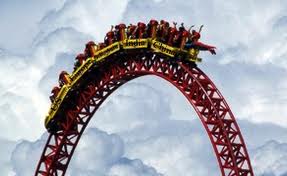
A good story is a roller coaster ride.  It takes readers through a series of twists and turns, saving the biggest thrill for last.  And, gravity being what it is, what goes up must come down.  It's not one continuous fast drop.  Indeed, the slow, steep inclines of anticipation can provide some of the biggest excitement.

Those ups and downs give a story its rhythm, much like breathing.  The action builds, then it lets up a bit, then builds again.  A story that builds and builds and never gives the reader a chance to catch their breath can be exhausting.  If the heart-pounding opening sequence of Raiders of the Lost Ark had  lasted for two hours without a break, brains would have melted.

An actual example of this (well, not the brain-melting part) is 2005's King Kong with Jack Black.  Fun movie with interesting variations on an old theme, but once they get to the jungle it's a nonstop series of action sequences.  The long prehistoric battles are exciting at first, but about the third or fourth one in, they lose their impact and even become tiresome because there isn't a quiet moment inbetween to remind us how amazing these scenes are.

We know that each scene in our story must further the plot, but we can accomplish this in a variety of ways besides continuous motion.  Sometimes the scene will be less about action and more about reaction; the result of what big thing just took place.  The bigger the thing, the more the audience will appreciate an opportunity to consider its implications.  Give them time to sort out the possibilities for themselves and you have a captive, involved audience.

After a scene with a car crash, the quietude of the patient lying in a hospital bed isn't just a natural aftermath, but a welcome opportunity to take a cleansing breath and ponder what the new developments will mean. 

Sometimes the pause itself provides the drama.  In the recent charmer Hope Springs with Meryl Streep and Tommy Lee Jones, a particularly important scene is followed by the lengthy closeup shot of a door, which, at that point, seems to last for an eternity.  As we look at the door we are filled with questions: 1) which door is this? 2) which of the two people will walk through it? 3) are they coming or going? 4) will the door even open? and 5) what are the ramifications of each of these scenarios?  It really is a brilliant and powerful silent story beat in its own right.

As a classic soft drink campaign once reminded us, it's the pause that refreshes.  Give your reader a chance to catch their breath before and after your roller coaster's big loops, and they'll stand in line to ride again.