Pages

Showing posts with label timing. Show all posts

January 9, 2018

Timing is Everything


by Gary Fearon, Creative Director, Southern Writers Magazine


A funny friend of mine used to love to say this joke:

"The most important thing when you're doing comedy is ... uh ... er ... timing!"

Well, it was funny when he said it.  

The inherent wisdom behind his witticism was that getting the time wrong throws things off-kilter. This isn't only true for punchlines, but for any kind of communication.  Perhaps even moreso when it's the written word.  Consider this passage:
Dan didn't know why he was waking up in a hospital bed.  One of the last things he remembered was talking to Eleanor and Bobby at the party.  He looked at his watch.  Almost 8.  He was in the mood for one more drink before he said goodnight.  A nurse then appeared at the doorway.  
If you were confused reading that, I was just as confused writing it.  Was Dan checking his watch at the party or at the hospital?  Did a nurse suddenly show up at the party?  It all becomes clear in context, but the reader isn't supposed to have to work that hard to sort it out.

Another example of off-timing is when mixing past and present tense:
Only after the plane took off did James realize his briefcase is back home on the dining room table.  In it were the wood samples that his entire presentation depends on.  It will require some clever ad-libbing to describe the different finishes he told Mr Shaw he'll have ready.
That's a pretty blatant example of terrible time-shifting.  In actual practice, opposing tenses tend to creep in much more subtly and stealthily, especially during dialogue segments.  Be on guard for "he said" and "he says" that try to share the same time frame.

Another time element that confuses many is the use of "was" versus "were" in statements such as:
"I wish I was homeward bound." (Simon & Garfunkel, 1966)
"I wish I were an Oscar Meyer Weiner." (TV commercial, 1965)
Only one of these is correct.  Which one is it?

In matters of non-reality, such as a wish or other imagining, the verb "were" helps to clarify, removing it from the realm of possibility.  No one would say, "I were homeward bound," but a sentence that includes "I was" could be taken incompletely to suggest "I was an Oscar Meyer weiner."  So songs like "If I Were a Carpenter" were correctly titled, while "If I Was Your Woman" wasn't.

These common mistakes in time and tense are easy to make, but just as easy to fix.  Developing good timing will help ensure that your writing is clear and linear and that both you and your reader have a good time.


January 13, 2015

Silence is Golden


by Gary Fearon, Creative Director, Southern Writers Magazine


One good turn deserves another, they say.  But in fiction, a good plot turn deserves a pause that lets the impact of what just happened sink in before anything else happens.

A particularly good example of the power of the pause is seen in 2011's The Descendants with George Clooney. Frequently, in the midst of a storyline filled with twists and turns, director Alexander Payne follows each big revelation with lingering shots of Hawaiian scenery. This gives the audience time to absorb the latest implications, as well as offering an ironic contrast of beauty in the midst of tragedy. The combination allows for rich moments of deep thought.

In a movie or TV show, that kind of timing is easily dictated in the editing booth.  When writing fiction, how are we to control the timing of our story so the audience feels that same moment of silence? Inserting a pause into a novel can be as simple as closing a scene or a chapter at the moment of impact:

          "I don't think she'll be coming in today."
          "Why not?"
          "She's dead."

          ***

If more dialogue or exposition is necessary before ending the scene, another technique is to stop the dialogue momentarily and allow the characters some reaction time:

          "I don't think she'll be coming in today."
          "Why not?"
          "She's dead."
          The blood drained out of Larry's face, and he thought he might pass out. He fumbled behind him for a chair, and slid into it. 
          "How did she die?"

If dialogue simply barrels along without acknowledging the shock of the moment, the reader is equally unlikely to feel its impact.  By pausing to provide a fitting visual, the character's reaction suggests what we hope will be the reader's own to each revelation.

Heavy-handed though they can be, soap operas know the value of zooming in on the stunned faces of the characters after any big announcement, giving the audience ample time to absorb the implications before cutting away to a commercial.  We can take a cue from  these masters of melodrama to effectively create pregnant pauses of our own.


October 23, 2012

Giving Them Pause


by Gary Fearon, Creative Director


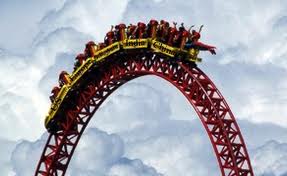
A good story is a roller coaster ride.  It takes readers through a series of twists and turns, saving the biggest thrill for last.  And, gravity being what it is, what goes up must come down.  It's not one continuous fast drop.  Indeed, the slow, steep inclines of anticipation can provide some of the biggest excitement.

Those ups and downs give a story its rhythm, much like breathing.  The action builds, then it lets up a bit, then builds again.  A story that builds and builds and never gives the reader a chance to catch their breath can be exhausting.  If the heart-pounding opening sequence of Raiders of the Lost Ark had  lasted for two hours without a break, brains would have melted.

An actual example of this (well, not the brain-melting part) is 2005's King Kong with Jack Black.  Fun movie with interesting variations on an old theme, but once they get to the jungle it's a nonstop series of action sequences.  The long prehistoric battles are exciting at first, but about the third or fourth one in, they lose their impact and even become tiresome because there isn't a quiet moment inbetween to remind us how amazing these scenes are.

We know that each scene in our story must further the plot, but we can accomplish this in a variety of ways besides continuous motion.  Sometimes the scene will be less about action and more about reaction; the result of what big thing just took place.  The bigger the thing, the more the audience will appreciate an opportunity to consider its implications.  Give them time to sort out the possibilities for themselves and you have a captive, involved audience.

After a scene with a car crash, the quietude of the patient lying in a hospital bed isn't just a natural aftermath, but a welcome opportunity to take a cleansing breath and ponder what the new developments will mean. 

Sometimes the pause itself provides the drama.  In the recent charmer Hope Springs with Meryl Streep and Tommy Lee Jones, a particularly important scene is followed by the lengthy closeup shot of a door, which, at that point, seems to last for an eternity.  As we look at the door we are filled with questions: 1) which door is this? 2) which of the two people will walk through it? 3) are they coming or going? 4) will the door even open? and 5) what are the ramifications of each of these scenarios?  It really is a brilliant and powerful silent story beat in its own right.

As a classic soft drink campaign once reminded us, it's the pause that refreshes.  Give your reader a chance to catch their breath before and after your roller coaster's big loops, and they'll stand in line to ride again.