Pages

Showing posts with label Sometimes the Little Town. Show all posts

August 22, 2022

Sense, Sentiment, & Sentimentality


Sara M. Robinson


No, I am not channeling some of Jane Austen. I’m leaving out “sensibility.” We know why we are here. From this poet’s view, I want to share the importance of those three words to a writer.


Let’s start with the definitions (from Webster’s New World Dictionary )and then expand the meanings for the composition of poetry.


Sense: to feel, perceive; an ability to judge, distinguish, discriminate, or estimate external conditions; an ability to feel, appreciate, understand, or comprehend some quality, such as humor; an ability to think or reason soundly.


We all agree that artists have a special “sense” when it comes to capturing the presence or essence of their craft. Think de Vinci and his “Mona Lisa.” Think Walt Whitman and his tome, Leaves of Grass. It is this sense that is the underlying driver for language that becomes the heart of poetry. In other columns, I have touched on aspects of sense, but this column is offering attention to differing uses of the root word, “sense.” Poetry draws upon the expansion of sense to give reason to what we observe or feel. In her poem, “Scraps,” Louise Glück has these lines which portray sense very well: “… I saw / Myself at seven learning / Distance at my mother’s knee…” The discovery by the child is her sense of her future.


Sentiment: a complex combination of feelings and opinions as a basis for action or judgment; general emotionalized attitude (i.e. patriotism); a thought, opinion, or attitude, usually a result of deliberation, but often colored with emotion; delicacy of feeling; appeal to the emotions in literature or art. For example, think of all the poetry by the Brownings. They called that era of writing and culture the Romantic era, for a reason. Here is the famous first line from Elizabeth Barrett Browning: “How do I love thee? Let me count the ways.” In contemporary American poetry, we read the very strong patriotism of Walt Whitman. He makes no attempt to hide his sentiment about America. I urge you to read his poem, “Salut au Monde!” Then read “I,Too” by Langston Hughes. This poem is the definition of “sentiment.”


Sentimentality: character, condition, or quality of being sentimental. With sentimental meaning having or showing tenderness, emotion, delicate feeling, etc. as in music or poetry. So let’s focus on poetry here. In the Romantic period, poets such as William Blake, William Wordsworth, and Mary Robinson, spent much of their writing energy on exultations of the human spirit. Poems dedicated to the seasons and many devoted to religion and innocence were frequently published.


Strict poetic forms were the norm along with antiquated language (by today’s standards).


We don’t so much write like that now, but I would draw you to the poetry of Charlotte Matthews and her book, Green Stars. I love these lines: “ the soul is like a trust, / like a cloud whose shape of angel or not, / is exactly what we need to be. //


Keep writing… with sense and sentiment


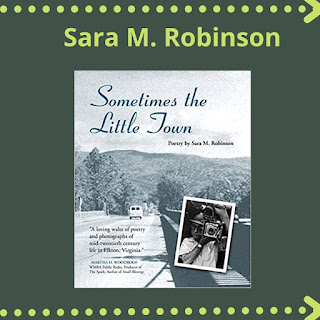
Sara M. Robinson, founder of the Lonesome Mountain Pro(s)e Writers’ Workshop, and former Instructor of a course on Contemporary American Poets at UVA-OLLI, was poetry columnist for Southern Writers Magazine and inagural poetry editor for Virginia Literary Journal. She has served as guest lecturer at UVA’s College at Wise, Wise, VA. Her poetry has appeared in various anthologies, including We Grew Wings and Flew (2014), Scratching Against the Fabric (2015), Virginia Writer’s Club Centennial Anthology (2017), Blue Ridge Anthologies and Mizmor Anthology (2018). Journals include: Loch Raven Review, The Virginia Literary Journal, vox poetica, Jimson Weed, Whisky Advocate, and Poetica. She is poet and author of Love Always, Hobby and Jessie (2009), Two Little Girls in a Wading Pool (2012), A Cruise in Rare Waters (2013 Stones for Words (2014), Sometimes the Little Town (2016), a finalist for the Poetry Society of Virginia’s 2017 Book Award. In 2019, Needville, her poetry about effects of coal mining on SW Virginia was released and in 2020 debuted as play in Charlottesville. Her most recent publication is Simple River (2020, Cyberwit).

https://saramrobinson.com/

December 22, 2021

Sara M. Robinson talks about, Southern Gothic Poetry, What Is It?


Sara M. Robinson


Recently I read an article about Southern Gothic Poetry. I had to ask myself just before diving into the article, is there such a thing? As Southern writers we’ve all heard about Southern Gothic novels. You know the ones: Large white mansion down a tree-lined drive, only the mansion is empty and covered with vines and Spanish moss. The shutters are broken, and the once-majestic staircase is missing steps and creaks at odd times. There is always a ghost or two, an old sword, an ancient caretaker who creeps around and never seems to leave. Oh, and yes, no electricity, but loads of candles. All is climaxed by the raging thunderstorm of the century. You can think of Faulkner and Flannery O’Connor as examples.


You now ask, what does this have to do with poetry? Well, for starters, the language of southern gothic writing is amazing. The visuals must be startling and complex. Everything has to be backed by haunts of historical proportion. The poetry, to not be dismissed as trite or hokey, needs to connect with basic human truths. So, who writes this type of poetry? Here are some names: C.D. Wright, Frank Stanford, Robert Penn Warren, James Dickey (of Deliverance fame), and Donald Justice. The imaginative placement and choice of words strikes me as potently differential. Here is what I mean, from Robert Penn Warren: “A door opening. I see / Your small form black against the light, and the door / Is closed, and I // Hear night crash down a million stairs. / In the ensuing silence / My breath is difficult. // Heat lighting ranges beyond the horizon. // That, also, is worth mentioning… What is special about this is use of night, black, silence, lightning… all good examples of southern writing.


For your reading enjoyment, here is my offering:


Short History of a Southern Mansion


Every Southern mansion with a mysterious past is called Twin Oaks. All have massive front yards with boxwoods and a shiny black gate at the end of a mile-long drive which creaks on rusted hinges when it opens.

In a raked dirt backyard near the kitchen porch a small vegetable garden with heirloom tomatoes and summer squash gourds, lavender-colored hollyhocks and a compost pile home for night crawlers.

Behind the chicken coop, a small green grass cemetery holds children’s pets: dogs, cats, turtles, a bunny. On a knoll tangled fences surround a family of tombstones dating back to before the Civil War. Like returned soldiers the ancient Bur Oak lost
a few limbs & gained a few scars. Thorns and thistles line the path leading down to the river. Spanish moss hangs like old weeping spinsters waiting for a trace of company. Fog and sheer curtains invite misty humid days inside where the damp can find a home on damask parlor chairs.


The fireplace is huge, deep, with a hidden staircase where Yankee ghosts make another pass. An old faded floor globe stands by cast iron Pal, Colonel’s favorite hunting dog.

Something always rattles in a far room on the top floor, followed by a not-so-subtle door creak. Maybe the breeze, then maybe not. Stairs moan a hollow sound of intrusion. Dust flies, then settles.

Luther, the ancient darkie handyman, and his wife, Loretta, who live back behind the kitchen either shell peas or roast a chicken on most days. Their three children, two boys and a girl, are grown and now live-in town. They spend Sundays here, always leave with a box of vegetables, some cured ham.

Colonel and his missus are the same age as Luther. Their children are long gone, too. They won’t come back but send letters imploring their folks to move into town
to an old-age home that fronts main street. The oldest boy is an attorney in the state capita with a trophy wife who heads up the local junior league. Neither like the country and when they have returned they always manage to either attract ticks or trip on an old dog. Some day the house will be too old to keep.

A young couple will buy the property and in the attic will discover an old trunk filled with uniforms, christening gowns, a few yellowed papers. A door will slam somewhere on the second floor. Upon further investigation a secret will be revealed. A secret so remarkable, so horrible that for years books will be written about it. Grade B Movies made. The house will burn down. In smoldering ashes, a lone firefighter will find an old, jeweled ring, still connected to a finger bone. Clean cut.


Until next time…


Sara M. Robinson, founder of the Lonesome Mountain Pro(s)e Writers’ Workshop, and former Instructor of a course on Contemporary American Poets at UVA-OLLI, was poetry columnist for Southern Writers Magazine and inagural poetry editor for Virginia Literary Journal. She has served as guest lecturer at UVA’s College at Wise, Wise, VA. Her poetry has appeared in various anthologies, including We Grew Wings and Flew (2014), Scratching Against the Fabric (2015), Virginia Writer’s Club Centennial Anthology (2017), Blue Ridge Anthologies and Mizmor Anthology (2018). Journals include: Loch Raven Review, The Virginia Literary Journal, vox poetica, Jimson Weed, Whisky Advocate, and Poetica. She is poet and author of Love Always, Hobby and Jessie (2009), Two Little Girls in a Wading Pool (2012), A Cruise in Rare Waters (2013 Stones for Words (2014), Sometimes the Little Town (2016), a finalist for the Poetry Society of Virginia’s 2017 Book Award. In 2019, Needville, her poetry about effects of coal mining on SW Virginia was released and in 2020 debuted as play in Charlottesville. Her most recent publication is Simple River (2020, Cyberwit).


https://saramrobinson.com/

April 7, 2020

What is the Normal Size of a Poem?

Sara Robinson    https://www.facebook.com/


What is the “normal” size of a poem? Is there a “calibration standard” for poetry length? We don’t use calipers or carpenter squares to measure length on a page. That is too left-brain for us creative types. But we do study and investigate words to ponder over stresses, syllables, and metrical formats, especially if we are writing formally (i.e. sonnets). Most of us contemporary poets embrace free verse style, so we think about compression and compaction when we compose. We edit a lot, revise a bunch, and throw away words that we decide will be unnecessary or even lazy.

Getting the words down, then getting them good is our faithful mantra. This also means words play a major role in length. The novelist Greg Iles says he writes “in a granular way,” meaning his descriptions often unfold minute-by-minute. That’s why most of his novels are long and epic. I love his writing.

March 3, 2020

Maintaining Control of Our Poetry


Sara Robinson   https://www.facebook.com/


This is not about ownership or authorship. This is not about how our poetry is like driving a car, per se. This is about stopping the runaway train of our writing. We’ve asked ourselves in the past, is this poem any good? Will anybody read it or like it? Do I even like it? Yes, we write many a line where we argue with ourselves about whether or not the writing is any good.

April 18, 2018

The Poetry of Activism We Witness


By Sara M. Robinson


I’ve been asked by many friends and associates why they haven’t seen any activist poetry from me. How do I write about current events? Or will I write about current events? Using poetry, I remarked that this is a very good and timely question. I struggled to provide an adequate answer, however. My hesitation is based on the major stumbling block for me: Where in the world would I start?


To write about world events and our own home country events is a challenge. We are compelled (theoretically, I think) as poets to be the witnesses of our surroundings then write about events in creative ways that provide thought provocation for our readers.

In a future Southern Writers Magazine column, titled “The Poetry of Witness,” I credit the amazing Carolyn Forché with coining that term. She describes in her writings what she sees as inequities of life around her. Another greatly admired poet, is Nikki Giovanni. Her memorable convocation after the Virginia Tech massacre of 2017 was and remains a powerful poetic statement and reminder about our history. 

So, how does all this come back to me? For one thing, as a poet, I constantly remind myself to be observant of all I can see. I take notes in my faithful companion journal. I talk to people and engage them to talk. One of my greatest pleasures is meeting weekly with senior citizen residents at a local retirement community. I use poetry from lots of sources to engage my attendees in conversation about their feelings and impressions. This is activism, using poetry as a “tool” to engage what I see as elderly folks wanting to stay relevant. Many of our weekly meetings inspire me to write poetry about the process of aging and the longevity of love. Often, I write poems for some of the attendees, to mark a birthday or some special event. Sometimes I’ve written poems as eulogy when the group has lost a member. In this way I suppose I have witnessed.

Now, back to the original question. While I may not be currently writing about politics or world events, I believe I write about life. I am a witness to life around me, and I use my poetry to advocate the beauty of living and the respect of aging; and lastly the hope I have gained wisdom of language to express all this in remarkable ways. A key component of my writing is to the creative use of language. After all, it is the basis for all that is human. Without language, we could only witness, we could not share.
______________________________________________________________________ 
Sara M. Robinson, award-winning poet, founder of the Lonesome Mountain Pro(s)e Writers’ Workshop, and former Instructor of a course on Contemporary American Poets at UVA-OLLI, is poetry columnist for Southern Writers Magazine and poetry editor for Virginia Literary Journal. In addition to publication in various anthologies, including We Grew Wings and Flew (2014), Scratching Against the Fabric (2015), and Virginia Writer’s Club Centennial Anthology (2017); journals: Loch Raven Review, The Virginia Literary Journal, vox poetica, Jimson Weed, and Poetica, she is poet and author of Love Always, Hobby and Jessie (2009), Two Little Girls in a Wading Pool (2012), A Cruise in Rare Waters (2013), and Stones for Words (2014). Her latest poetry book, Sometimes the Little Town, released in February 2016, was a finalist for the Poetry Society of Virginia’s 2017 Book Award.


May 24, 2017

How I Describe My Particular Craft: Composition of Poetry


By Sara M. Robinson


For me it is a misnomer to say I write poetry. It’s not like I set out to write an essay or even a fictional prose piece. I have to cast about my thoughts in such a way that my lines and stanzas provide pauses for the reader to stop and think about what I have written. This is actually tough for me as I have always been a “gabber” with my mantra of “why say in 30 words when 300 will work. So, I say I work at” composing” poetry. This has served me to learn more about the discipline of careful selection and contemplation of what to write, and say.

As in any craft in which the artist has a strong emotional investment, practice is a key component. If I am not writing, then I use the time for reading. I allocate a block of time to write and think, at least 2 hours a day. I have a dedicated writing space, which is my domain on good days, my catacomb on dark days. But I have a great view of a big oak tree rising above our apricot tree, which stands guard over the lilacs and this view never
fails to keep me grounded. Even when I can watch an approaching storm I can sense a
transfer of energy.

Many artists start their craft or their creative passion(s) early in their lives. I was not that lucky. Poetry came late to me, after I turned 65. Many of my poetry contemporaries had at least a 40-year head-start. I’ve had a lot of catching up to do in a short time. I am only 70 now. And the flip side of this is that I want my poetry to be relevant to the younger writers, too. One way I do this is by attending conferences at colleges and spending time on campus in English departments interacting with emerging writers. Young people today are smart and savvy. I have to be as good a wordsmith as I can be to keep up with them, compete with them, and be included with them.

For active poets, newly-minted poets, and even those who simply want to read poetry, I would offer that my regular column, Poetry Matters, in Southern Writers Magazine, could be a useful tool. The major focus of the column is to present the art of writing poetry in a user-friendly manner without the intimidation of academic scrutiny. I am a community poet so I work on the accessibility of poetry to mainstream readers. After all this is where poetry started. Poetry can be and should be accessible to everyone and anyone who enjoys reading.

So, as I compose poetry, I want to be a witness to the world, whether it is nature, society, or the big area in between. Then give this witness to readers. The reader then determines if the poems give enlightenment, education, entertainment, or all three.
__________________________________________________________________
Sara M. Robinson, award-winning poet, founder of the Lonesome Mountain Pros(e) Writers’ Workshop, and Instructor of a course on Contemporary American Poets at UVA-OLLI, is poetry columnist for Southern Writers Magazine and poetry editor for Virginia Literary Journal. In addition to publication in various anthologies, including We Grew Wings and Flew (2014) and Scratching Against the Fabric (2015), and journals: Loch Raven Review, The Virginia Literary Journal, vox poetica, and Poetica, she is poet and author of Love Always, Hobby and Jessie (2009), Two Little Girls in a Wading Pool (2012), A Cruise in Rare Waters (2013), and Stones for Words (2014). Her latest poetry book, Sometimes the Little Town, released in February 2016, is a finalist for the Poetry Society of Virginia’s 2017 Book Award.