

Seven years ago, readers around the country fell in love with a singular American voice: Rinker Buck, whose infectious curiosity about history launched him across the West in a covered wagon pulled by mules and propelled his book about the trip, The Oregon Trail, to ten weeks on the New York Times bestseller list. Now, Buck returns to chronicle his latest incredible adventure: building a wooden flatboat from the bygone era of the early 1800s and journeying down the Mississippi River to New Orleans.
A modern-day Huck Finn, Buck casts off down the river on the flatboat Patience accompanied by an eccentric crew of daring shipmates. Over the course of his voyage, Buck steers his fragile wooden craft through narrow channels dominated by massive cargo barges, rescues his first mate gone overboard, sails blindly through fog, breaks his ribs not once but twice, and camps every night on sandbars, remote islands, and steep levees. As he charts his own journey, he also delivers a richly satisfying work of history that brings to life a lost era.
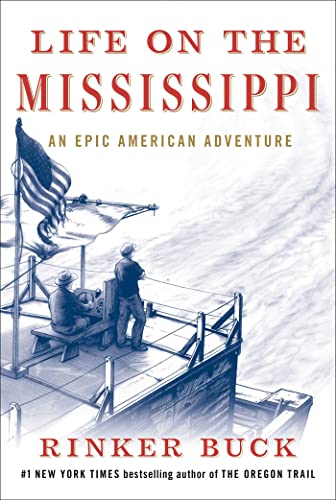
The role of the flatboat in our country’s evolution is far more significant than most Americans realize. Between 1800 and 1840, millions of farmers, merchants, and teenage adventurers embarked from states like Pennsylvania and Virginia on flatboats headed beyond the Appalachians to Kentucky, Mississippi, and Louisiana. Like the Nile, the Thames, or the Seine before them, the western rivers in America became a floating supply chain that fueled national growth. Settler families repurposed the wood from their boats to build their first cabins in the wilderness; cargo boats were broken apart and sold to build the boomtowns along the water route. Joining the river traffic were floating brothels, called “gun boats”; “smithy boats” for blacksmiths; even “whiskey boats” with taverns mounted on jaunty rafts. In the present day, America’s inland rivers are a superhighway dominated by leviathan barges—carrying $80 billion of cargo annually—all descended from flatboats like the ramshackle Patience, which must avoid being crushed alongside their metal hulls.
As a historian, Buck resurrects the era’s adventurous spirit, but he also challenges familiar myths about American expansion, confronting the bloody truth behind settlers’ push for land and wealth. The Indian Removal Act of 1830 forced more than 125,000 members of the Cherokee, Choctaw, and several other tribes to travel the Mississippi on a brutal journey en route to the barrens of Oklahoma. Simultaneously, almost a million enslaved African Americans were carried in flatboats and marched by foot 1,000 miles over the Appalachians to the cotton and cane fields of Arkansas, Mississippi, and Louisiana, birthing the term “sold down the river.” Weaving together a tapestry of first-person histories, Buck portrays this watershed era of American expansion as it was really lived.
With a rare narrative power that blends stirring adventure with absorbing untold history, Life on the Mississippi is a muscular and majestic feat of storytelling from a writer who may be the closest that we have today to Mark Twain.
Here is a video of his journey on The Oregon Trail
Rinker Buck began his career in journalism at the Berkshire Eagle and was a longtime staff writer for the Hartford Courant. He has written for Vanity Fair, New York, Life, and many other publications, and his stories have won the Eugene S. Pulliam National Journalism Writing Award and the Society of Professional Journalists Sigma Delta Chi Award. He is the author of The Oregon Trail as well as the acclaimed memoirs Flight of Passage and First Job. He lives in northwest Connecticut.
Find Rinker on Facebook


